

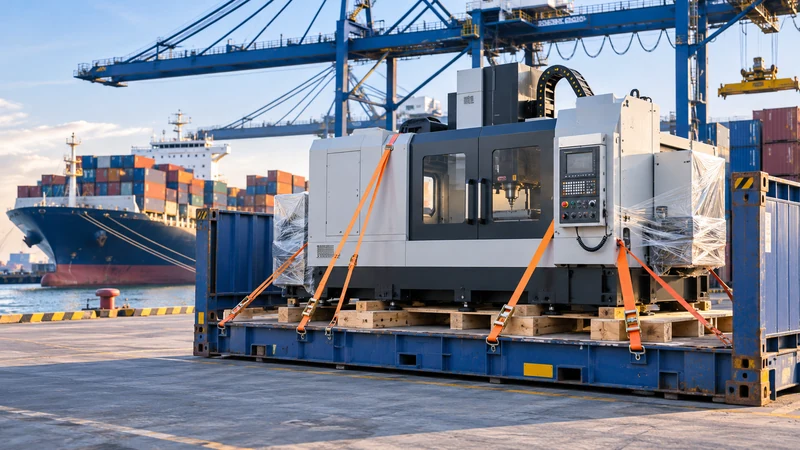
Shipping industrial machinery from China to the USA requires choosing transportation equipment that matches the machine’s packed dimensions, weight, lifting requirements, and final delivery conditions. Most container-compatible machinery can travel by ocean freight, while oversized or unusually heavy equipment may require open-top containers, flat racks, or specialized cargo arrangements.
For U.S. importers, the planning process extends beyond booking a container. Machinery must be properly packed and secured, import documents must be accurate, and the receiving factory must be prepared for delivery and unloading.
This guide explains how to evaluate machinery shipping methods, prepare equipment for international transport, understand U.S. import requirements, compare freight costs, and coordinate delivery from a Chinese manufacturer to an American industrial facility.
1. What Must Importers Check Before Shipping Industrial Machinery?
Before requesting freight rates, obtain accurate technical information about the machinery. Its size, weight, construction, and handling requirements will determine which shipping methods are feasible.
Confirm the Machine’s Actual Shipping Dimensions and Weight
Start with the manufacturer’s technical specifications, but distinguish the machine’s operating dimensions from its final shipping dimensions.
Export packaging, protective frames, wooden skids, and protruding components can increase the cargo’s overall dimensions. These differences may affect container selection, loading feasibility, and freight charges.
Request the following information from your Chinese supplier:
- Machinery identification: Equipment type, manufacturer, model, and function.
- Packed dimensions: Length, width, and height of each shipping unit.
- Gross weight: Total weight of each packed unit, including packaging.
- Package quantity: Number of machines, crates, and accessory packages.
- Shipping configuration: Fully assembled, partially dismantled, or separated into multiple units.
- Technical documentation: Equipment drawings, photographs, and handling instructions.
For production lines comprising several machines, request individual specifications rather than relying only on the total shipment weight.
A machine may fit inside a container before packing but become too tall or wide once its export frame is installed.
Identify Lifting Points, Center of Gravity, and Load Distribution
Machinery weight alone does not determine whether it can be loaded safely.
A compact industrial press, for example, may place considerable weight on a small base. Even if its gross weight falls within a container’s nominal payload capacity, concentrated floor loading could make the proposed arrangement unsuitable.
The freight planning team should confirm:
- Manufacturer-approved lifting points or forklift pockets.
- Center-of-gravity location.
- Machine base dimensions and weight distribution.
- Required crane or forklift capacity.
- Whether the machine must remain upright.
- Whether a dedicated lifting frame or engineered support structure is necessary.
These details help determine loading equipment, container suitability, and cargo-securing requirements.
Confirm Machinery Condition and Special Handling Requirements
Different industrial machines have different transportation risks.
CNC machines and precision measuring equipment may contain sensitive components. Injection molding machines may have heavy moving assemblies. Industrial pumps and hydraulic equipment may contain fluids that require special preparation.
Importers should also identify batteries, fuel, compressed gases, and other potentially regulated components before booking.
For used machinery, obtain condition photographs and confirm that the equipment has been prepared for transportation according to the manufacturer’s instructions.
Practical takeaway: A reliable freight assessment should begin with final packed specifications, not approximate catalog dimensions.
2. Which Shipping Method Is Suitable for Industrial Machinery?
Ocean freight is often the practical starting point for shipping industrial machinery from China to the United States. However, the correct shipping equipment depends on more than the machine’s physical size.
The shipment must be suitable for loading, securing, carrier acceptance, and inland delivery.
Standard Containers: When Are 20-Foot, 40-Foot, and High-Cube Containers Suitable?
Standard full container load (FCL) shipping can accommodate many types of industrial equipment, including appropriately packed CNC machines, manufacturing equipment, compressors, and industrial pumps.
Common container options include:
- 20-foot containers: Often considered for compact, relatively heavy equipment when payload and floor-loading conditions permit.
- 40-foot containers: Useful for longer machinery or multiple shipping units when weight distribution is acceptable.
- 40-foot high-cube containers: Provide additional internal height but do not eliminate door-clearance, weight, or loading restrictions.
Three checks are particularly important.
First, the machine must fit through the container door using the proposed loading method. Internal container dimensions alone are insufficient.
Second, the floor and structural arrangement must support the machine’s concentrated loads.
Third, the packed machine must be capable of being safely positioned and secured inside the container.
A larger container is not automatically the correct solution for heavier machinery. Equipment selection should reflect the complete loading arrangement and the actual container specifications.
Open-Top Containers: When Does Overhead Loading Make More Sense?
An open-top container may be appropriate when machinery cannot be loaded conveniently through the doors of a standard enclosed container.
Removing the rigid roof permits overhead loading, making this equipment potentially suitable for certain tall machines or cargo requiring crane placement.
An open-top container may also accommodate some overheight shipments, subject to carrier acceptance.
However, importers must confirm:
- The machine’s dimensions relative to the equipment.
- Available lifting and terminal facilities.
- Weight distribution and securing arrangements.
- Weather protection requirements.
- Whether the cargo extends beyond the equipment’s permitted envelope.
Not every open-top shipment is out-of-gauge (OOG). Cargo may require overhead loading while remaining within the permitted equipment dimensions.
Flat-Rack Containers: When Are They Needed for Oversized Machinery?
Flat-rack containers are often considered for machinery with dimensions or configurations unsuitable for enclosed containers.
Potential applications include wide industrial presses, large production equipment, and irregularly shaped machinery.
Because flat racks have an open structure, the cargo-securing arrangement requires particular attention.
The carrier or appointed technical specialist may request:
- Detailed cargo drawings.
- Verified packed dimensions and weight.
- Center-of-gravity information.
- Photographs of the machinery and support frame.
- Proposed loading and securing arrangements.
If the cargo exceeds the equipment’s permitted dimensional envelope, it may be classified as OOG and require additional approval and specialized stowage.
Flat-rack acceptance is not automatic. The carrier must assess the actual cargo and proposed transport arrangement.
When Should Buyers Consider Breakbulk, LCL, or Air Freight?
Some machinery cannot be transported economically or safely using standard container arrangements.
Breakbulk or project cargo shipping may be considered for exceptionally large or heavy equipment that cannot be handled through suitable containerized arrangements. Availability depends on vessel services, port facilities, cargo dimensions, and lifting arrangements.
Less than container load (LCL) shipping may work for smaller machinery that can be adequately crated and handled within a consolidation network. However, shared freight handling can introduce additional transfer points and packaging requirements.
Air freight may be appropriate for compact, high-value machinery or urgent replacement equipment. The shipment must satisfy aircraft, cargo-handling, dimensional, and any applicable special-cargo restrictions.
Machinery Shipping Method Decision Matrix
| Machinery characteristics | Potential shipping method | Critical checks |
|---|---|---|
| Fits within standard container limits | Standard FCL | Door clearance, payload, floor loading, securing |
| Requires loading from above | Open-top container | Lifting method, height, securing, carrier approval |
| Overwidth or irregularly shaped | Flat-rack container | Dimensions, center of gravity, OOG approval |
| Cannot use available container equipment | Breakbulk/project cargo | Vessel capacity, port handling, engineering assessment |
| Small, adequately protected equipment | LCL | Packaging, consolidation handling, acceptance |
| Compact and time-sensitive equipment | Air freight | Aircraft acceptance, cargo restrictions, total cost |
Consider three hypothetical examples:
A compact CNC machine with suitable lifting points and dimensions may be a candidate for a standard FCL container.
A tall industrial press that cannot pass through a container door may require evaluation for overhead loading.
A wide manufacturing machine with an irregular base may require a flat-rack or project cargo assessment.
These are preliminary options, not confirmed shipping solutions.
Before selecting any method, verify that the machinery can be loaded, secured, accepted by the carrier, transported inland, and unloaded at the destination.
3. How Should Industrial Machinery Be Packed, Loaded, and Secured in China?
Industrial machinery can be exposed to vibration, movement, moisture, and repeated handling during international transportation.
Suitable export packing helps reduce damage risks, but packing methods must reflect the equipment’s specific design and transport conditions.
Prepare the Machine for Transport
The Chinese supplier or appointed technical contractor should follow the manufacturer’s transport preparation instructions.
Depending on the machinery, preparation may involve:
- Securing movable mechanical assemblies.
- Protecting precision surfaces and exposed components.
- Securing or separately packing detachable accessories.
- Protecting electrical controls and sensitive instruments.
- Applying appropriate corrosion and moisture protection.
- Assessing hydraulic fluids, batteries, fuel, and other potentially regulated materials.
- Recording the machine’s condition before packing.
For precision equipment, the manufacturer may specify additional vibration, tilt, or environmental restrictions.
Do not assume that fluids must always be drained or components removed. These decisions depend on the equipment and applicable transport requirements.
Choose Appropriate Industrial Crating and Support Structures
Common industrial packing solutions include engineered wooden crates, heavy-duty skids, steel frames, and other purpose-designed support structures.
The packaging should protect the equipment while allowing safe lifting and handling.
For heavy machinery, the strength of the supporting base is particularly important. An inadequate skid can fail even when the external crate appears secure.
Importers should verify that the packaging arrangement:
- Supports the machine’s weight and load distribution.
- Provides suitable lifting access.
- Protects sensitive components.
- Prevents unwanted movement.
- Accommodates the intended cargo-securing system.
- Can be handled at the destination.
Wood packaging compliance matters for U.S. imports.
Regulated solid-wood crates, pallets, skids, and dunnage entering the United States must comply with applicable ISPM 15 requirements.
The USDA Animal and Plant Health Inspection Service (APHIS) requires regulated wood packaging material to be appropriately treated and marked. Certain alternatives, including qualifying processed-wood products and nonwood packaging, are treated differently.
Importers should check the packaging before shipment rather than assuming the Chinese supplier has used compliant materials.
Official reference: USDA APHIS — Importing ISPM 15-Compliant Wood Packaging.
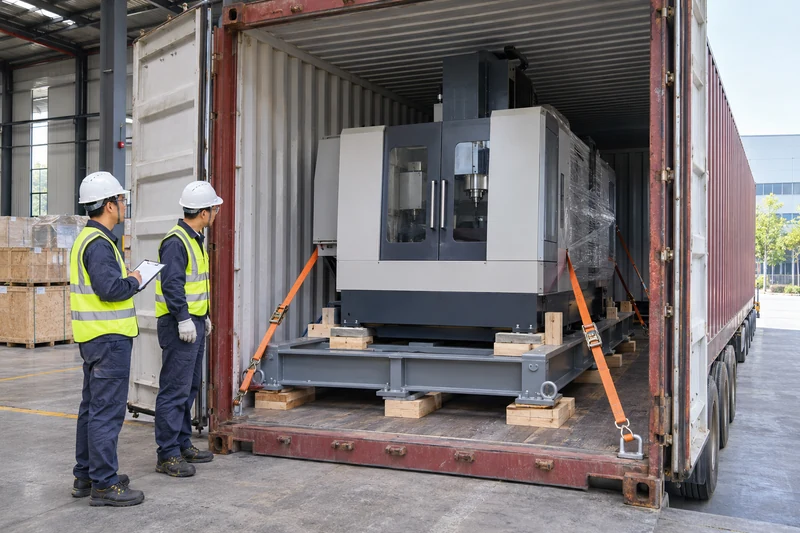
Verify Loading, Blocking, Bracing, and Lashing
Packing the machine is only one part of cargo preparation.
During container loading, the equipment must be positioned and secured to withstand the expected transportation conditions.
Important considerations include the center of gravity, floor loading, support points, securing equipment, and movement during sea and land transport.
The responsible packing or handling contractor should prepare a suitable loading and securing arrangement, obtaining technical review or carrier approval where required.
The IMO/ILO/UNECE CTU Code provides recognized guidance on cargo packing and securing. It is a non-mandatory code of practice and does not replace applicable regulations, carrier requirements, or engineering assessment.
What Packing Evidence Should the Buyer Request?
Before the cargo is released, ask the supplier or packing contractor for:
- Final packed dimensions and weights.
- Photographs of the machine before packing.
- Photographs of the completed packaging.
- Lifting and center-of-gravity information.
- Loading and securing records where applicable.
- ISPM 15 markings or supporting packaging evidence where applicable.
- Container and seal details when containerized.
These records help the importer, freight coordinator, and receiving facility understand how the machinery has been prepared.
They may also assist with documenting cargo condition if a transportation problem occurs.
4. What Documents and U.S. Import Checks Are Required for Industrial Machinery?
Industrial machinery imported into the United States must satisfy applicable customs requirements. Some machines may also be subject to additional product-specific regulations.
The importer should review these requirements before the equipment leaves China.
Prepare Machinery-Specific Commercial and Shipping Documents
The basic documentation commonly includes:
Commercial invoice: Identifies the seller, buyer, machinery description, quantity, declared value, and other information required for customs entry.
Packing list: Describes the shipping units, package quantities, dimensions, gross weights, and packing configuration.
Bill of lading or air waybill: Identifies the cargo and relevant transportation parties.
Technical specifications: Provide details about the machine’s function, model, construction, and components when necessary for classification or regulatory review.
A description such as “one industrial machine” may be insufficient for an accurate customs assessment.
A better commercial description identifies the actual equipment type and function, supported by its model and technical specifications.
For example, identifying an item as a CNC milling machine is more informative than describing it only as manufacturing equipment.
The precise information required depends on the machinery and customs entry.
Confirm HTSUS Classification and Applicable Import Charges
Industrial machinery is classified under the Harmonized Tariff Schedule of the United States (HTSUS).
Different machines can fall under different tariff provisions based on their functions, technical characteristics, and configurations.
Many machinery and electrical equipment products fall within Chapters 84 or 85, but classification must be determined for the specific merchandise.
Importers should review:
- The applicable HTSUS classification.
- The ordinary customs duty rate.
- Additional duties or measures applicable to the product and origin.
- Relevant Section 301 measures and any valid exclusions.
- Antidumping or countervailing duties where applicable.
- Customs fees associated with the entry.
There is no single import duty rate that applies to every industrial machine shipped from China to the USA.
Tariff treatment can also change. A classification or duty estimate prepared during the purchasing stage should therefore be checked again for the actual import transaction.
Official resources include:
- USITC — Harmonized Tariff Schedule
- USTR — Section 301 Tariff Search
- International Trade Administration — AD/CVD Guidance
The importer or its customs specialist should confirm the correct classification and current duty treatment before finalizing landed-cost estimates.
Clarify Importer of Record, Customs Broker, and ISF Responsibilities
The Importer of Record (IOR) is responsible for fulfilling applicable customs entry obligations, including exercising reasonable care in classification, valuation, and the accuracy of information provided to U.S. Customs and Border Protection (CBP).
A licensed customs broker may handle entry preparation and filing for an authorized importer, but engaging a broker does not automatically remove the IOR’s legal responsibilities.
The parties should confirm the IOR arrangement, broker authorization, customs bond, and necessary shipment information before departure.
For applicable ocean cargo, Importer Security Filing (ISF) information must generally be submitted before the cargo is loaded onto the vessel destined for the United States.
The principal advance ISF filing deadline is generally 24 hours before vessel loading, although certain information is subject to different deadlines. Special categories, including certain breakbulk arrangements, require separate applicability checks.
Ordinary air freight is not subject to maritime ISF requirements.
Official reference: CBP — Import Security Filing.
Which Product-Specific Requirements Should Be Checked?
Not all industrial machines have identical certification or regulatory requirements.
Engine-driven equipment: Machinery containing regulated nonroad engines may be subject to EPA emissions and import requirements. Check the actual engine and equipment configuration.
Electrical equipment: Applicable OSHA workplace electrical safety rules and Nationally Recognized Testing Laboratory requirements may affect equipment used in U.S. workplaces. These are not universal customs certificates for all machinery.
Used machinery: The importer should confirm the machine’s condition, classification, valuation, documentation, and any product-specific restrictions.
Specialized machinery: Additional agency requirements may apply depending on the machine’s function, components, and intended use.
Relevant references include EPA import guidance and OSHA’s NRTL guidance.
Customs admissibility and compliance with workplace installation or operational requirements are related but separate matters.
Importers should obtain product-specific advice when the applicable requirements are unclear.
5. What Does Industrial Machinery Shipping Cost, and Who Pays for Each Stage?
The cost of shipping industrial machinery from China to the USA depends on the equipment’s physical characteristics, transportation method, handling requirements, and delivery destination.
Two machines with similar gross weights may have very different freight costs if one fits into a standard container and the other requires specialized equipment.
Identify the Main Machinery Shipping Cost Components
A useful machinery freight budget separates charges by transportation stage.
| Shipping stage | Potential cost components | Main cost drivers |
|---|---|---|
| China origin | Factory pickup, inland transport, packing, loading, export handling | Factory location, lifting needs, equipment size |
| International freight | Ocean or air freight, special equipment, OOG handling, insurance if arranged | Cargo dimensions, route, equipment availability |
| U.S. destination | Terminal handling, customs brokerage, bond-related costs, inland delivery | Arrival port, import requirements, final destination |
| Specialized services | Permits, cranes, rigging, special vehicles | Load configuration, road restrictions, site conditions |
| Contingent charges | Storage, demurrage, detention, waiting charges | Delays, free-time terms, handling arrangements |
Import duties and applicable government fees should be identified separately from transportation charges.
For example, the U.S. Merchandise Processing Fee (MPF) may apply to relevant customs entries, while the Harbor Maintenance Fee (HMF) applies to qualifying maritime cargo movements.
Applicable rates and charges should be checked against current CBP requirements.
For oversized machinery, origin lifting, specialized transportation, and destination unloading can materially affect the total cost.
A port-to-port ocean freight quotation does not necessarily include these services.
How Do Incoterms Change Machinery Shipping Responsibilities?
The agreed Incoterm affects which party arranges and pays for transportation, clearance, and delivery obligations.
For machinery shipments, the most important practical distinctions include:
FCA (Free Carrier): The delivery point determines how cargo handover works. Where delivery occurs at the seller’s premises, seller loading obligations differ from delivery at another named place.
FOB (Free on Board): Used for sea and inland waterway transport, with delivery occurring when goods are placed on board the vessel. It should not automatically be selected for every containerized machinery shipment.
DAP (Delivered at Place): The seller arranges carriage to the agreed destination and generally delivers the goods ready for unloading. The buyer handles import clearance and duties.
DPU (Delivered at Place Unloaded): The seller is responsible for unloading at the named destination, while import clearance normally remains the buyer’s responsibility.
DDP (Delivered Duty Paid): The seller assumes import clearance and duty obligations under the term. However, the arrangement must be legally and operationally feasible, including the IOR and any product-specific requirements.
For heavy machinery, the parties should explicitly agree who provides cranes, forklifts, and rigging at both origin and destination.
The ICC Incoterms 2020 rules provide the authoritative framework for these contractual responsibilities.
How Can Importers Compare Machinery Freight Quotations?
Before selecting a proposal, check whether it includes:
- Pickup at the Chinese factory.
- Machinery packing and securing.
- Specialized container or carrier approval costs.
- Export handling and documentation.
- International freight.
- U.S. terminal and customs coordination.
- Applicable inland transportation.
- Permits, crane handling, or unloading.
- Cargo insurance, if required.
- Possible additional or contingent charges.
Compare quotations with the same origin, destination, cargo specifications, and service scope.
A lower ocean freight rate does not necessarily mean a lower total delivery cost.
6. How Does Industrial Machinery Move from a Chinese Factory to the Export Port?
Transport preparation begins at the manufacturer’s premises.
For heavy or oversized machinery, the inland journey to the Chinese export port may require separate planning from the ocean freight movement.
Confirm Factory Pickup and Inland Transport Feasibility
Before arranging collection, confirm the factory’s loading capabilities and the route to the intended port.
Important checks include:
- Factory access and loading space.
- Availability of suitable lifting equipment.
- Machine weight and transport configuration.
- Required truck or specialized trailer.
- Local road restrictions and applicable permits.
- Cargo readiness and collection schedule.
Machinery that cannot move safely as one assembled unit may need to be separated into transportable components, subject to manufacturer approval.
The final dimensions and weights must reflect the actual configuration to be collected.
Coordinate Export Documents, Loading, and Port Acceptance
Once the transport method has been assessed, the origin-side team must coordinate export documentation, carrier booking, terminal requirements, and cargo delivery.
For packed containers, the Verified Gross Mass (VGM) requirement is particularly important.
Under SOLAS requirements, the shipper identified under the applicable rules is responsible for providing the verified gross mass in advance of vessel loading.
A packed container without the required VGM information cannot be loaded under the applicable SOLAS requirements.
Official reference: IMO — Verification of the Gross Mass of a Packed Container.
Special cargo may also require additional technical information and carrier acceptance before terminal delivery.
What Can Delay Machinery Before Vessel Departure?
Common preparation problems include incomplete technical drawings, changed cargo dimensions, unavailable lifting equipment, insufficient packing, and delayed special-cargo approval.
Export documentation discrepancies and missed terminal cutoffs may also affect the shipping schedule.
For these reasons, machinery freight planning should begin before the supplier declares the equipment fully ready for shipment.
7. How Do You Arrange Machinery Delivery from a U.S. Port to the Final Factory?
The U.S. arrival port is not necessarily the final delivery point.
For industrial machinery, inland transportation and unloading can require as much operational attention as the international freight movement.
Select the U.S. Arrival Port Based on the Final Destination
The preferred U.S. gateway depends on the receiving factory, available ocean services, cargo dimensions, and inland transportation options.
Possible gateways include Los Angeles/Long Beach, New York/New Jersey, Savannah, and Houston, depending on routing and cargo acceptance.
For specialized equipment, importers should verify:
- Whether the port and terminal can handle the cargo configuration.
- Availability of suitable inland transportation.
- The distance and practical route to the receiving facility.
- Customs release and terminal collection arrangements.
- Special equipment availability at the destination.
A port offering a competitive ocean freight rate may not provide the most economical overall delivery route.
Arrange Specialized Inland Transport When Required
Standard container-compatible machinery may be delivered using ordinary container drayage where the load and transport arrangement meet applicable limits.
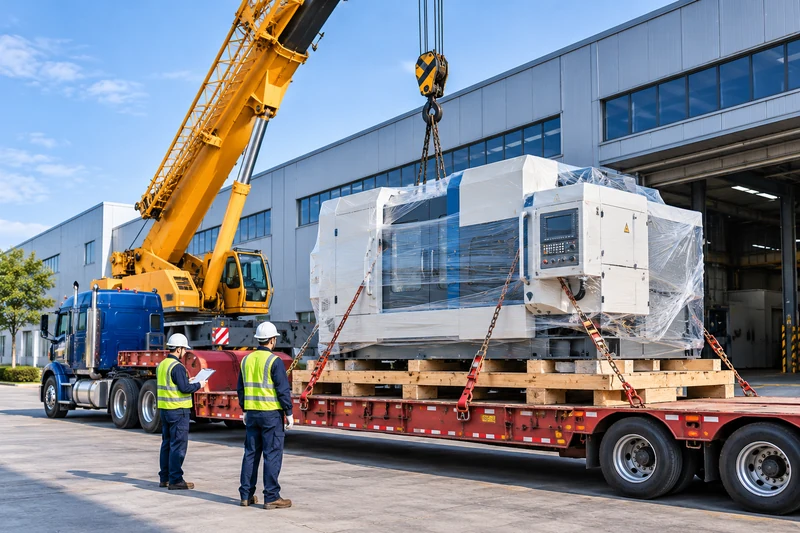
Oversized or exceptionally heavy machinery may require flatbed trucks, lowboy trailers, or specialized heavy-haul equipment.
Depending on the shipment, additional arrangements may include:
- State oversize or overweight permits.
- Approved trucking routes.
- Height and width clearance assessments.
- Bridge and axle-load considerations.
- Escort vehicles.
- Specialist loading or transfer operations.
In the United States, oversize and overweight permits are generally administered by individual states rather than issued through one universal federal permit.
Official reference: Federal Highway Administration — Oversize/Overweight Load Permits.
If the route crosses multiple states, the transport provider must assess the applicable requirements along the journey.
Verify the Factory’s Unloading and Receiving Conditions
Before arranging final delivery, confirm that the destination can receive the machinery.
Relevant information includes:
- Factory entrance dimensions.
- Road and turning access.
- Ground-level versus loading-dock delivery.
- Available crane or forklift equipment.
- Suitable unloading surfaces.
- Rigging contractor availability.
- Receiving hours and appointment requirements.
- The agreed delivery and unloading location.
The buyer should also determine whether the machine is to be unloaded near the factory entrance or moved into a specific building area.
These may involve different equipment, responsibilities, and costs.
Factory delivery, unloading, machinery positioning, installation, and commissioning are separate activities unless expressly included in the agreed service scope.
Document Delivery and Any Visible Damage
The receiving team should inspect the external packaging and accessible cargo condition before completing the delivery acknowledgment.
Where possible, record visible damage with photographs and written delivery exceptions.
If damage or discrepancies are discovered, notify the relevant transportation and insurance parties promptly and follow the applicable contractual claims procedures.
Keep the commercial invoice, packing list, shipping documents, and loading photographs available for reference.
8. What Should You Confirm Before Booking a Machinery Shipment?
A successful machinery shipment begins with a coordinated plan covering technical feasibility, import preparation, transportation, and final delivery.
The following process brings these requirements together.
Follow a Six-Step Machinery Shipment Planning Process
Step 1 — Collect final machinery specifications.
Obtain packing drawings, dimensions, gross weights, photographs, center-of-gravity information, and handling restrictions from the Chinese supplier.
Step 2 — Assess the complete transportation route.
Determine whether the machinery can be collected, loaded, shipped, discharged, transported inland, and unloaded at the destination.
Step 3 — Verify U.S. import readiness.
Confirm the importer arrangement, customs classification, documentation, and any applicable product-specific requirements.
Step 4 — Define responsibilities and service scope.
Agree on the Incoterm, packing, lifting, export arrangements, import clearance, inland transport, unloading, and insurance responsibilities.
Step 5 — Review the final freight proposal.
Confirm the selected equipment, technical approval status, included services, exclusions, and shipment schedule.
Step 6 — Coordinate the transportation milestones.
Track cargo preparation, origin loading, vessel departure, U.S. customs release, inland movement, and factory delivery.
Pre-Shipment Readiness and Responsibility Checklist
The following checklist can be used with the Chinese supplier, freight coordinator, customs broker, and U.S. receiving facility.
| Checkpoint | Primary responsible party* | Required confirmation |
|---|---|---|
| Packed dimensions and weights | Supplier/packer | Final packing details |
| Lifting points and center of gravity | Supplier | Technical drawings or instructions |
| Freight equipment assessment | Freight coordinator/carrier | Suitability and required acceptance |
| Cargo packing and securing | Appointed packing contractor | Packing and securing records |
| Wood packaging compliance | Supplier/packer | Applicable ISPM 15 markings |
| U.S. import classification | Importer/customs specialist | Classification review |
| Customs entry arrangements | IOR/customs broker | Authorization and required documents |
| ISF, where applicable | ISF importer/authorized agent | Filing arrangements |
| Inland transport feasibility | Appointed transport provider | Equipment, routing, permits |
| Factory unloading readiness | U.S. consignee/appointee | Access and unloading confirmation |
Responsibilities shown are typical coordination roles, not automatic contractual assignments. Actual obligations depend on the transaction, applicable law, and agreed services.
All critical items should be confirmed before the shipment proceeds to the relevant operational stage.
Machinery Freight Quotation Worksheet
To prepare an accurate machinery freight request, provide the following information.
| Information | Details to provide |
|---|---|
| Machinery type | Equipment name, model, and function |
| Condition | New or used |
| Quantity | Number of machines and packages |
| Packed dimensions | Length × width × height per package |
| Gross weight | Weight of each packed unit |
| Lifting details | Lifting points, center of gravity, restrictions |
| Cargo documents | Technical drawings and photographs |
| China origin | Supplier pickup address and cargo-ready date |
| USA destination | Delivery address, city, state, and ZIP code |
| Unloading | Available equipment and site restrictions |
| Import information | IOR arrangement and HTSUS code, if confirmed |
| Commercial terms | Agreed or proposed Incoterm and named place |
| Required services | Pickup, freight, customs coordination, delivery, unloading |
| Schedule | Requested shipment and delivery planning window |
An initial freight assessment can begin even if some technical information is incomplete. However, final equipment acceptance and reliable pricing may require additional documentation.
Sharing accurate specifications at the beginning helps avoid unnecessary quotation revisions and unsuitable transportation proposals.
For a broader overview of routes and freight options, see shipping from China to the USA.
Request a Freight Quote for Your Machinery Shipment
Importers can share the machinery specifications, Chinese pickup location, U.S. delivery address, and required services with Winsail to discuss an appropriate transportation arrangement.
FAQ
Can a heavy CNC machine be shipped in a standard 20-foot container?
Yes, some heavy CNC machines can be transported in standard 20-foot containers, provided the packed equipment meets the applicable dimensional, loading, structural, and weight-distribution requirements. The machine's gross weight alone is insufficient to determine suitability. Final loading feasibility and container selection must be verified.
Can industrial machinery be shipped without a wooden crate?
Yes. Depending on the equipment, suitable steel frames, engineered skids, or other packaging arrangements may be used. The packaging must provide adequate protection, support, and handling access. The supplier, packing contractor, and carrier should confirm whether the proposed arrangement is acceptable.
Can used industrial machinery be imported from China into the United States?
Used industrial machinery can often be imported into the United States, but applicable requirements depend on the actual equipment. Importers must provide accurate product descriptions and values and verify classification, condition, and relevant regulatory requirements. Engine-driven or other specialized equipment may require additional checks.
Does door-to-door machinery shipping include crane unloading at the U.S. factory?
Not automatically. Door-to-door transportation may end at the agreed delivery location without including specialist crane unloading or rigging. The parties must confirm which services are included. Contractual terms such as DAP and DPU can create different unloading responsibilities.
How early should an importer arrange shipping for oversized machinery?
Planning should begin once sufficiently accurate technical drawings and destination details are available. Oversized cargo may require specialized equipment availability checks, engineering review, carrier acceptance, and inland permits. These requirements can affect scheduling, so buyers should avoid waiting until the machinery is ready for immediate collection.
Should industrial machinery shipments have cargo insurance?
Cargo insurance is worth evaluating, particularly for high-value or damage-sensitive machinery. Importers should confirm who arranges coverage, the insured value, applicable risks, exclusions, deductibles, and claims procedures. Freight liability and cargo insurance are not the same, and coverage should be reviewed against the specific shipment.
Conclusion: Plan the Entire Machinery Transport Chain Before Booking
Shipping industrial machinery from China to the USA requires more than selecting an ocean freight service. The appropriate solution depends on the machine’s dimensions, weight distribution, loading requirements, import conditions, and final delivery location.
Importers should begin with accurate technical specifications, confirm packaging and customs readiness, and establish clear responsibilities for transportation and unloading.
Comparing complete freight arrangements rather than isolated ocean freight rates can help identify missing services and potential additional costs.
With these details prepared, buyers can work with Winsail to evaluate suitable China-to-USA shipping options and plan the movement of machinery to their U.S. facilities.