

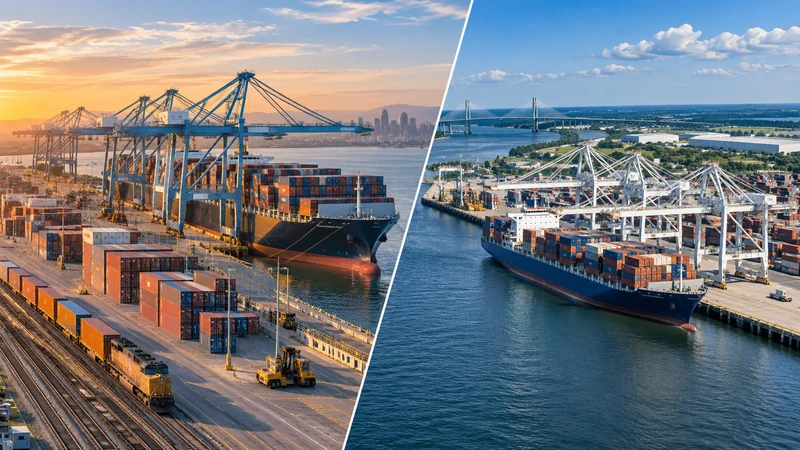
Choosing between West Coast and East Coast ports is an important decision for U.S. businesses importing commercial goods from China. The best option depends on more than ocean transit time or the freight rate to the destination port.
West Coast ports generally offer a shorter ocean journey from China, making them attractive for shipments destined for California, the Pacific Northwest, and certain inland markets. East Coast ports may provide a more suitable total delivery route for importers with warehouses in the Northeast, Southeast, or other locations served by Atlantic gateways.
For inland destinations such as Chicago, both coasts may be worth comparing. Ocean schedules, rail connections, inland trucking, terminal handling, and warehouse requirements can change the result.
This guide explains how to select a U.S. arrival port based on total transportation cost, realistic delivery time, cargo configuration, and final warehouse location.
1. Which U.S. Coast Makes the Most Sense for Your Final Delivery Location?
The most useful starting point is your final U.S. delivery address, not simply the closest port to your Chinese supplier.
A container discharged at Los Angeles may still need a long inland rail journey. Conversely, a container arriving in Savannah or New York/New Jersey may require only regional trucking to reach its destination.
West Coast Ports for Western U.S. Distribution
The main Pacific gateways to consider include:
- Los Angeles and Long Beach: Major Southern California container gateways serving regional warehouses and inland intermodal markets.
- Oakland: An option for Northern California importers and distribution networks.
- Seattle and Tacoma: Pacific Northwest gateways serving Washington, Oregon, and selected inland destinations.
For a warehouse near Los Angeles, a Southern California gateway is usually an appropriate starting point because it can limit inland transportation distance.
However, an importer should still compare actual sailing availability, destination terminal charges, trucking arrangements, and receiving requirements.
The Port of Los Angeles also provides extensive on-dock and near-dock rail infrastructure, making it relevant to shipments moving beyond California.
East Coast Ports for Eastern and Southeastern Distribution
Major Atlantic gateways include:
- New York/New Jersey: Relevant for Northeast distribution and intermodal connections to inland markets.
- Savannah: A significant Southeast container gateway with highway and intermodal rail connections.
- Norfolk and other Port of Virginia terminals: Options for Mid-Atlantic distribution and inland rail transportation.
- Charleston: A Southeast gateway serving regional manufacturing, distribution, and connected inland markets.
These ports should not be evaluated solely by their distance from the Chinese loading port.
For example, a Savannah arrival may be operationally attractive for a warehouse in Georgia, while New York/New Jersey may be more convenient for a distribution center in northern New Jersey.
Which Coast Should Midwest Importers Evaluate?
Midwest destinations require a more detailed comparison.
A Chicago importer may receive cargo through a West Coast gateway with onward rail transportation. Alternatively, an East Coast gateway may provide a suitable intermodal service.
The correct choice depends on the complete route rather than which coastline appears geographically closer.
U.S. Port Selection by Delivery Region
| Final U.S. Destination | Gateways Worth Evaluating | Main Decision Factor |
|---|---|---|
| Southern California | Los Angeles, Long Beach | Local trucking and terminal access |
| Northern California | Oakland, Los Angeles/Long Beach | Carrier service and regional delivery cost |
| Pacific Northwest | Seattle, Tacoma | Available services and warehouse location |
| Northeast | New York/New Jersey, Virginia where suitable | Inland distance, rail connections, and delivery schedule |
| Southeast | Savannah, Charleston, Virginia | Regional trucking and inland rail options |
| Midwest | West Coast or East Coast gateways with intermodal connections | Total transportation cost and warehouse delivery time |
| Multiple U.S. warehouses | Single gateway, multiple gateways, or transloading options | Shipment volume and distribution requirements |
This table is an initial screening tool, not a fixed port ranking. The available carrier service and actual warehouse ZIP code must determine the final shortlist.
For destinations in Texas and surrounding regions, Gulf Coast gateways such as Houston may also deserve consideration as a separate routing category.
2. How Do Shipping Routes Differ Between West Coast and East Coast Ports?
There are three main transportation arrangements importers should understand: a Pacific arrival with local delivery, a Pacific arrival with inland transportation, and an Atlantic arrival with local or inland transportation.
Direct Trans-Pacific Shipping to West Coast Gateways
China-to-West-Coast ocean services generally cross the Pacific to reach ports such as Los Angeles, Long Beach, Oakland, Seattle, or Tacoma.
Common Chinese export gateways include Shanghai, Ningbo, Yantian/Shenzhen, and Qingdao.
Depending on the carrier and origin port, shipments may use a direct vessel service or require transshipment.
A direct call can reduce the number of ocean transportation handoffs, but it does not guarantee the earliest warehouse delivery date. Vessel frequency, departure cut-offs, terminal availability, and inland arrangements remain important.
For businesses receiving cargo close to a Pacific port, the container may move from the marine terminal directly to the warehouse by truck once the necessary release requirements are satisfied.
West Coast Arrival Followed by Intermodal Rail
Intermodal transportation combines ocean shipping with rail movement.
A typical arrangement is:
China export port → Los Angeles/Long Beach → inland rail terminal → final U.S. warehouse
After vessel discharge, the container may be transferred to an on-dock or near-dock rail facility.
The rail operator moves the container to an inland terminal, where a truck completes the final delivery.
Three locations should be distinguished:
- Port of discharge: Where the vessel unloads the container.
- Inland rail ramp: Where the container becomes available after rail transportation.
- Final delivery address: The customer’s warehouse or distribution center.
These locations may be hundreds or thousands of miles apart.
An importer should confirm whether the quoted service includes rail transportation, destination-ramp handling, final trucking, chassis, and other applicable charges.
All-Water Shipping to East Coast Gateways
All-water services carry containers from Asia to Atlantic U.S. gateways without requiring a transcontinental U.S. rail movement before reaching the arrival port.
Depending on the service, routing may involve the Panama Canal or another ocean corridor.
Actual routes can change because of carrier network adjustments, canal operating conditions, security concerns, and vessel diversions.
For importers with receiving warehouses near Savannah, Charleston, Virginia, or New York/New Jersey, an all-water service followed by local trucking may be a practical alternative to West Coast entry.
However, an all-water route should not automatically be described as cheaper or more reliable.
East Coast Arrival Followed by Inland Rail
East Coast ports also have substantial intermodal capabilities.
The Port of New York/New Jersey operates the ExpressRail network. Savannah’s Mason Mega Rail facility supports inland transportation, while the Port of Virginia has rail connections to several major inland markets.
Charleston also provides rail connectivity through regional intermodal facilities and inland-port arrangements.
Consequently, the meaningful comparison is not simply West Coast rail versus East Coast trucking.
It is a comparison of complete, available routes from the Chinese origin to the specific U.S. receiving location.

3. Is West Coast or East Coast Shipping Faster to the Final Warehouse?
West Coast ports generally have a shorter ocean crossing from China than Atlantic gateways on comparable direct services.
However, the shortest ocean voyage is not necessarily the fastest warehouse delivery route.
Importers should compare the full cargo-ready-to-delivery timeline.
Why Port-to-Port Transit Time Is Not Enough
A vessel ETA indicates expected arrival at a port. It does not mean that a container is released, available for pickup, or ready for warehouse delivery.
A typical commercial ocean shipment involves several stages:
| Transportation Stage | What Affects Delivery Time |
|---|---|
| China origin handling | Factory readiness, pickup, export procedures, and vessel cut-off |
| Ocean transportation | Vessel rotation, transshipment, sailing schedule, and diversions |
| U.S. terminal handling | Vessel discharge, container availability, and terminal processing |
| Customs and cargo release | Documentation, clearance status, examinations, and applicable holds |
| Inland transportation | Rail departures, ramp processing, trucking, and equipment availability |
| Warehouse receiving | Appointments, operating hours, unloading capacity, and delivery restrictions |
A realistic shipping plan includes all these stages.
When a West Coast Routing May Be Faster
West Coast routing is particularly worth considering when the shipment has a suitable trans-Pacific sailing and the receiving location is in the Western United States.
It may also be competitive for an inland warehouse if the ocean arrival and connecting rail schedule provide an attractive overall delivery window.
For time-sensitive replenishment cargo, the importer should compare the estimated warehouse delivery date rather than selecting the sailing with the earliest port arrival.
A faster vessel service can lose its advantage if the container waits for rail transportation or a warehouse receiving appointment.
When East Coast Shipping May Offer a Competitive Delivery Window
An Atlantic gateway can be advantageous when the destination warehouse is close to the arrival port.
Even though the ocean voyage may be longer, the shipment may avoid a lengthy inland rail transfer.
East Coast rail connections can also make Atlantic gateways competitive for some inland destinations.
However, the actual outcome depends on the booked carrier service and inland transportation schedule.
How Should Importers Plan for Delays?
Possible disruptions include blank sailings, missed transshipment connections, terminal congestion, customs examinations, rail-ramp delays, and limited warehouse appointments.
Importers should establish two separate milestones:
- Estimated vessel arrival date: When the ship is expected to reach the destination port.
- Estimated warehouse delivery date: When the cargo is expected to reach the receiving facility.
For inventory planning, the second milestone is more important.
Businesses working with strict replenishment deadlines should also agree on a reasonable planning buffer based on the selected route, current operating conditions, and consequences of late delivery.
There is no universal delay allowance that is appropriate for every China–USA shipment.
4. Which Route Has the Lower Total Transportation Cost?
The cheapest ocean freight quotation does not always produce the lowest cost to the final U.S. warehouse.
A West Coast route may have a shorter ocean leg but require substantial inland transportation. An East Coast all-water route may reduce inland distance for an Eastern warehouse, but its ocean freight and destination charges may differ.
The useful comparison is total transportation cost to the same final delivery location.
Why Ocean Freight Rates Alone Can Be Misleading
Consider an importer receiving a 40-foot container at a warehouse in Pennsylvania.
One quotation covers ocean freight from China to Los Angeles. Another covers ocean freight to New York/New Jersey.
Comparing those two port-to-port prices would not identify the lower-cost delivery option.
The Los Angeles quotation may require transcontinental rail, destination-ramp handling, and final trucking. The New York/New Jersey quotation may involve a shorter inland move.
Both routes must be evaluated to the same warehouse address before a meaningful cost comparison is possible.
Which Charges Should Be Included?
| Cost Component | What to Confirm |
|---|---|
| China origin handling | Pickup, export handling, and applicable terminal charges |
| Ocean freight | Base freight, surcharges, and routing inclusions |
| U.S. terminal handling | Destination terminal and release-related charges |
| Inland rail | Rail transportation and applicable ramp charges |
| Drayage and chassis | Container pickup, local transport, and equipment requirements |
| CFS or transloading | Deconsolidation or transfer to domestic equipment |
| Final trucking | Delivery to the receiving warehouse |
| Customs brokerage and bond | Applicable clearance-related service costs |
| Additional charges | Storage, demurrage, detention, missed appointments, and other accessorials |
Not every charge applies to every shipment. Some may already be included in a through-freight quotation.
Avoid double-counting charges that are included in another quoted component.
Customs duties, tariffs, and applicable government fees should also be identified, but they should be shown separately from the port-routing cost comparison.
Choosing a different U.S. coastline does not automatically change the import duty treatment of the merchandise.
Why Incoterms and Quotation Scope Matter
The agreed Incoterm affects who arranges transportation, which costs each party bears, and the point at which risk transfers.
For example:
- FOB: Under the agreed terms, the seller delivers goods on board the vessel at the named shipment port, and the buyer generally arranges main carriage.
- CFR/CIF: The seller contracts and pays for carriage to the named destination port, although risk transfers at shipment under these rules. CIF also requires the seller to arrange the specified insurance coverage.
- DAP: The seller arranges carriage to the named destination, while import clearance and duties generally remain the buyer’s responsibility.
- DDP: The seller assumes additional import clearance and duty responsibilities, subject to legal feasibility and the specific contract.
FOB, CFR, and CIF are maritime terms. For containerized multimodal shipments, FCA, CPT, or CIP may be more appropriate depending on the actual delivery arrangement.
The International Chamber of Commerce’s Incoterms guidance explains these distinctions.
A port-to-port freight price under one arrangement should not be compared directly with a delivered price under another.
West Coast vs East Coast Cost Comparison Worksheet
An importer evaluating two feasible routes can use the following structure:
| Comparison Item | Option A: West Coast + Inland | Option B: East Coast + Inland |
|---|---|---|
| China origin | Same origin | Same origin |
| Final U.S. destination | Same ZIP code | Same ZIP code |
| Container or cargo details | Identical | Identical |
| Incoterm / quoted scope | Confirm | Confirm |
| Ocean freight | Quoted amount | Quoted amount |
| U.S. terminal charges | Quoted amount | Quoted amount |
| Rail transportation | If applicable | If applicable |
| Drayage and chassis | Quoted amount | Quoted amount |
| CFS / transloading | If applicable | If applicable |
| Final warehouse delivery | Included or separate | Included or separate |
| Brokerage and bond | Identified separately | Identified separately |
| Potential accessorial charges | Conditions disclosed | Conditions disclosed |
| Total comparable transportation cost | Calculate | Calculate |
| Estimated warehouse delivery | Confirm window | Confirm window |
Both quotations should use the same cargo-ready assumptions, container specifications, delivery address, and equivalent service scope.
Importers should also check quotation validity, payment terms, equipment conditions, and free-time allowances.
A route with a slightly higher base transportation cost may still be commercially preferable if it provides a better delivery window or reduces material operational risks.

5. Does FCL or LCL Shipping Affect Which U.S. Port You Should Choose?
Yes. FCL and LCL shipments can have different destination handling requirements, which may affect the choice of arrival port.
FCL Port Selection Considerations
Full Container Load (FCL) shipping allows a container to move through an agreed transportation chain without routine cargo deconsolidation.
A container can be delivered directly from a marine terminal or transported through an inland rail network.
Important considerations include:
- Container size, weight, and equipment availability.
- Rail and trucking connections.
- Warehouse unloading capability.
- Chassis arrangements.
- Container free time and empty-return requirements.
- Cargo-specific handling restrictions.
For machinery, large commercial equipment, or heavier cargo, buyers should confirm the equipment and applicable road or rail weight limitations before choosing a route.
A standard container is not automatically suitable for every cargo configuration.
LCL Port Selection Considerations
Less than Container Load (LCL) shipping combines cargo from multiple shippers into a consolidated container.
After arrival, cargo must be deconsolidated and made available for individual release and delivery.
This makes the location of the Container Freight Station (CFS) particularly important.
An LCL shipment may discharge at one ocean port but become available for collection at another designated facility after an onward movement.
Importers should check:
- The actual cargo-availability location.
- Deconsolidation and release procedures.
- CFS handling and storage charges.
- Final trucking distance.
- The time between vessel arrival and cargo availability.
The closest ocean port is not necessarily the most economical LCL delivery option.
When Does Transloading Make Sense?
Transloading involves transferring cargo from an international shipping container into another vehicle or domestic container.
It may be useful when cargo must be distributed to several warehouses or when a domestic transportation arrangement is commercially attractive.
However, transloading introduces additional handling, labor, packaging considerations, and potential damage exposure.
The decision should reflect cargo characteristics and distribution requirements, not just transportation price.
6. What Operational and Customs Risks Could Change the Best Port Choice?
A port may appear suitable based on location, ocean transit, and freight cost but become less attractive when operational constraints are considered.
Port, Rail, and Trucking Constraints
Before booking, importers should confirm the destination terminal, inland transportation plan, and receiving requirements.
Key risks include terminal congestion, unavailable truck appointments, limited chassis availability, rail-ramp delays, and container return restrictions.
Two charges deserve particular attention:
Demurrage generally relates to containers or cargo remaining at a marine terminal beyond the applicable free time.
Detention generally relates to keeping carrier equipment outside the terminal beyond the applicable free time.
Definitions and billing arrangements depend on the governing terms and circumstances.
Importers should establish who monitors the last free day, arranges container pickup, coordinates return of equipment, and addresses any disputed charges.
The Federal Maritime Commission provides guidance on detention and demurrage billing requirements. Applicable rules and contractual terms should be checked rather than assuming every charge has the same billing responsibility.
U.S. Customs Requirements That Affect Routing
The selection of a West Coast or East Coast port does not eliminate U.S. customs obligations.
The Importer of Record remains responsible for applicable entry requirements, classification, valuation, duties, and import compliance.
A licensed customs broker can prepare and submit relevant customs documentation, but using a broker does not automatically remove the importer’s legal responsibilities.
For commercial ocean shipments, Import Security Filing (ISF) requirements must also be addressed before departure. For standard U.S.-bound ocean cargo, most required ISF information must generally be submitted at least 24 hours before cargo is loaded aboard the vessel at the foreign port, subject to the applicable timing rules.
The importer or appointed filing agent should confirm the exact requirements. See CBP’s ISF guidance.
Importers should prepare accurate commercial invoices, packing lists, transport documents, importer information, and any product-specific supporting records.
What Happens if Cargo Moves Under Bond to an Inland U.S. Port?
A container moving by rail into the United States’ interior is not automatically moving under customs bond.
Two different arrangements may apply:
- Cargo receives the necessary customs release before continuing as a domestic inland movement.
- Cargo moves under an authorized in-bond procedure to another U.S. port of entry, where the relevant entry and clearance arrangements are completed.
CBP’s Immediate Transportation guidance describes the procedures associated with qualifying in-bond movements.
Importers should confirm the planned customs entry location and responsible parties with their carrier and customs broker.
A customs release also should not be confused with physical cargo availability. A container may still require terminal, carrier, rail, or other release arrangements before delivery.
What Should Be Rechecked Before Booking?
Current conditions can change the attractiveness of a route.
Importers should confirm:
- The actual carrier service and departure schedule.
- The destination terminal and inland rail connection.
- Equipment and trucking availability.
- Free-time conditions and applicable accessorial charges.
- Customs filing and release responsibilities.
- Warehouse receiving appointments.
- Any cargo-specific import or handling requirements.
These checks are especially important for high-value industrial equipment, time-sensitive inventory, and shipments with limited warehouse receiving flexibility.
7. How Can Importers Choose Between West Coast and East Coast Shipping Before Booking?
A practical port-selection process begins with the final destination and eliminates routes that cannot meet the shipment’s essential requirements.
Step 1 — Confirm Your Final U.S. Delivery Location
Provide the complete receiving address, including ZIP code.
Also confirm warehouse hours, appointment requirements, unloading capabilities, and whether cargo is intended for one or multiple locations.
A warehouse ZIP code is more useful for routing decisions than simply stating that the shipment is destined for the United States.
Step 2 — Identify Feasible Ocean and Inland Routes
For each candidate gateway, confirm:
- Chinese export location and available loading port.
- Carrier service and cargo cut-off.
- Vessel departure and arrival schedule.
- Direct or transshipment arrangement.
- Destination terminal.
- Inland rail or trucking connection.
- Cargo and equipment compatibility.
Remove options that cannot meet essential requirements, even if their theoretical ocean transit appears attractive.
Step 3 — Compare the Same Transportation Scope
Ask for quotations covering the same shipment and delivery location.
Review total transportation charges, estimated warehouse delivery windows, customs responsibilities, storage exposure, and service exclusions.
A useful comparison should explain not only the proposed route but also why it is suitable.
Step 4 — Select the Route Based on Business Priorities
| Business Priority | What to Prioritize |
|---|---|
| Lowest delivered transportation cost | Complete, comparable route charges |
| Earliest inventory arrival | Feasible final warehouse delivery window |
| Regular inventory replenishment | Schedule consistency and repeatable inland arrangements |
| Multiple warehouses | Distribution flexibility and transloading requirements |
| Sensitive or high-value cargo | Equipment suitability, handling stages, and protection |
| Limited warehouse receiving hours | Reliable appointment and local trucking coordination |
The lowest transportation price is not always the best overall supply-chain decision.
Practical Example: Shipping One Container from Shanghai to Chicago
Consider a hypothetical U.S. importer purchasing a full container of commercial products from a supplier near Shanghai.
The cargo will be delivered to a distribution center in the Chicago metropolitan area.
The importer is comparing two potential routes.
Route A — West Coast Entry
Shanghai → Los Angeles/Long Beach → inland intermodal rail → Chicago-area rail ramp → final warehouse.
This route offers a potential advantage from the shorter trans-Pacific ocean leg.
However, the importer must consider rail availability, inland transfer costs, container handling, and final trucking.
Route B — East Coast Entry
Shanghai → a suitable East Coast container gateway → inland intermodal rail → Chicago-area rail ramp → final warehouse.
This option may have a longer ocean journey but offers a different inland transportation arrangement.
The importer should evaluate the complete lead time and cost.
Before selecting either route, the following questions must be answered:
- Is a suitable carrier service available for the intended departure?
- Does the proposed rail service connect the arrival terminal with the required inland market?
- What is the total transportation cost to the same Chicago warehouse?
- What is the realistic estimated delivery window?
- Are terminal charges, chassis, storage conditions, and final trucking included?
- Which party is responsible for customs clearance and equipment returns?
Neither route can be declared the winner without these details.
This example illustrates why gateway selection should be based on the complete transportation chain rather than the ocean leg alone.
What Information Is Needed for a Route Comparison?
Importers preparing to compare routes should provide:
- Chinese supplier or pickup address.
- Cargo-ready date.
- Commercial cargo description.
- Shipment volume, gross weight, and dimensions.
- FCL container type or LCL shipment specifications.
- Final U.S. warehouse address and ZIP code.
- Agreed Incoterm.
- Required delivery window.
- Warehouse receiving conditions.
- Any special cargo handling requirements.
With these details, a freight forwarder can evaluate available ocean and inland transportation arrangements under a consistent set of assumptions.
Winsail coordinates China-origin international freight transportation and related logistics services. For importers evaluating U.S. gateways, the objective is to identify a feasible route that matches the cargo, destination, budget, and delivery requirements.
Request a Freight Quote to compare shipping options for your China-origin cargo and final U.S. destination.
For a broader overview of available transportation methods, see shipping from China to the USA.
FAQ
Is shipping through a West Coast port always faster than an East Coast port?
No. West Coast services generally involve a shorter ocean crossing from China, but total delivery time depends on inland transportation and destination handling. For an Eastern U.S. warehouse, an East Coast arrival followed by regional trucking may offer a competitive delivery window. Compare estimated warehouse delivery dates instead of vessel transit times alone.
Which coast should I use for a container shipped from China to Chicago?
Both West Coast and East Coast intermodal routes may be suitable, depending on available services. A Chicago importer should compare the complete route, including vessel schedule, inland rail service, destination ramp, final drayage, and total transportation cost. The most suitable gateway depends on the actual shipment rather than a universal geographic rule.
Does choosing a different U.S. arrival port change customs duties?
Choosing a different U.S. coastline does not automatically change the applicable import duty rate. Duty treatment depends on factors such as product classification, customs value, origin, and applicable trade measures. Port handling expenses and customs brokerage arrangements may differ between locations, but these should not be confused with changes to statutory import duties.
Can I choose the U.S. destination port if my Chinese supplier arranges ocean freight?
That depends on the sales contract, Incoterm, and transportation agreement. If the seller controls the ocean freight booking, the buyer may have limited ability to change the destination port after arrangements have been made. Buyers who need a particular gateway should confirm the requested routing and destination with their supplier before finalizing the shipping agreement.
Should I compare Gulf Coast ports when shipping to Texas?
Yes, depending on the Chinese origin, available ocean services, and final delivery address. Gulf Coast gateways such as Houston may be worth evaluating for Texas or nearby regional distribution. They represent a separate routing category and should not be grouped with Atlantic East Coast ports. Compare their complete transportation costs and schedules against feasible Pacific or Atlantic alternatives.
How does LCL shipping change the choice of U.S. arrival port?
LCL cargo usually requires deconsolidation before individual shipments can be released. As a result, the location of the destination CFS, handling charges, cargo availability, and final trucking arrangements may be more important than the ocean discharge port alone. Importers should compare the total cost and delivery time to the receiving warehouse rather than relying solely on a port-to-port LCL freight rate.
Conclusion: Choose the Best Complete Route, Not Just the Nearest Port
West Coast and East Coast ports serve different transportation and distribution needs for commercial cargo imported from China.
West Coast gateways generally offer a shorter ocean crossing, while East Coast gateways can provide practical advantages for Eastern destinations and selected inland markets. Both coasts have intermodal rail capabilities.
The right decision depends on the final U.S. warehouse location, shipment specifications, available carrier services, inland transportation costs, customs arrangements, and realistic delivery requirements.
Before booking, compare feasible routes using the same cargo details, cost inclusions, and final delivery address.
Discuss Your Shipment with Winsail to evaluate ocean freight and inland delivery arrangements for commercial cargo originating in China.